


 PLATFORM UPDATE:

Thermodynamic analysis of the decomposition of scheelite by oxalic acid
 *ab
*ab
Abstract
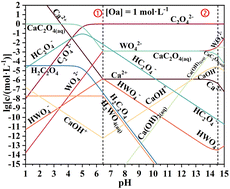
The equilibrium diagram of the Ca–W–Oa–H2O system for the H2C2O4 leaching of scheelite at 298 K was constructed. This diagram clarifies the dominant regions of each component in the system as well as the variation rules of key components with pH value and total concentration of free H2C2O4, thereby confirming the thermodynamic conditions for the H2C2O4 leaching of scheelite. Theoretical analysis results indicate that H2C2O4 can effectively leach scheelite, and the concentration of H2C2O4 is a crucial factor influencing the leaching efficiency. When 1 < pH < 6.4, scheelite reacts with H2C2O4 to form precipitates of H2WO4(s) and CaC2O4(s). Under the condition of maintaining a high concentration of free H2C2O4(aq), H2WO4(s) further reacts with H2C2O4(aq), and the formation of H2[WO3(C2O4·H2O)] with high solubility is predicted, which promotes the leaching of scheelite. When 6.4 < pH < 14.6, the ionization of H2C2O4 is enhanced with the increase of pH, leading to the rise in the concentrations of C2O42− and WO42−. When pH > 14.6, the binding effect between OH− and Ca2+ in the system is sharply strengthened, and CaC2O4(s) is gradually converted into Ca(OH)2(s). Based on the thermodynamic analysis results, experimental verification of H2C2O4 leaching of scheelite was carried out. Under the optimal conditions of H2C2O4 concentration of 2.2 mol L−1, reaction temperature of 80 °C, reaction time of 5 h, liquid-to-solid ratio of 15 : 1, and stirring speed of 100 rpm, the leaching rate of WO3 reached 99.54%, with only 0.53% of WO3 remaining in the leaching residue. Comparison of the XRD, EDS, and FTIR characterization results of raw scheelite and oxalic acid-leached residue reveals that during the leaching process, most of the tungsten enters the leachate in a highly soluble form, while calcium combines with C2O42− to form CaC2O4·H2O precipitate, which is retained in the leaching residue.
 Please wait while we load your content...


