Issue 19, 2026, Issue in Progress

Selective Functionalization of 1-substituted-3-arylquinoxalin-2(1H)-ones via C–H activation

Abstract

Over the past few decades, transition-metal-catalyzed selective functionalization of C–H bonds has fascinated the scientific community by offering striking advantages in comparison to traditional methods, such as high atom economy, a reduced number of reaction steps, and milder reaction conditions. Moreover, directing-group-assisted C–H activation enhances the significance of transition-metal catalysis further by enabling precise and site-selective functionalization. This mini-review outlines recent advancements in the imine-directed, transition-metal-catalyzed selective functionalization of N-alkyl-3-phenylquinoxalin-2(1H)-ones, highlighting C–C, C–O, C–X (X = Cl, Br, and I), C–S, and C–Se bond formation reactions and mechanistic aspects of these transformations.
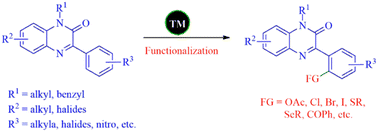
Graphical abstract: Selective Functionalization of 1-substituted-3-arylquinoxalin-2(1H)-ones via C–H activation

Article information

Article type
Review Article
Submitted
02 Feb 2026
Accepted
12 Mar 2026
First published
30 Mar 2026
This article is Open Access
Creative Commons BY-NC license

RSC Adv., 2026,16, 17005-17020

Selective Functionalization of 1-substituted-3-arylquinoxalin-2(1H)-ones via C–H activation

P. Kumar, Priya, S. Dutta, D. Mishra and N. Kumar, RSC Adv., 2026, 16, 17005 DOI: 10.1039/D6RA00901H

This article is licensed under a Creative Commons Attribution-NonCommercial 3.0 Unported Licence. You can use material from this article in other publications, without requesting further permission from the RSC, provided that the correct acknowledgement is given and it is not used for commercial purposes.

To request permission to reproduce material from this article in a commercial publication, please go to the Copyright Clearance Center request page.

If you are an author contributing to an RSC publication, you do not need to request permission provided correct acknowledgement is given.

If you are the author of this article, you do not need to request permission to reproduce figures and diagrams provided correct acknowledgement is given. If you want to reproduce the whole article in a third-party commercial publication (excluding your thesis/dissertation for which permission is not required) please go to the Copyright Clearance Center request page.

Read more about how to correctly acknowledge RSC content.

Social activity

Spotlight

Advertisements