


 PLATFORM UPDATE:


Novel glycidyl azide polymers containing aromatic diol units: synthesis and characterization for their application as energetic composite propellant binders
 *ab
Dang Thi
Tuyet Anh,
ab
Vu Quang
Hung,
c
Nguyen Thi
Quynh Giang,
ab
Nguyen Tuan
Anh,
ab
Nguyen Ha
Thanh,
ab
Nguyen
Van Tuyen
*ab
*ab
Dang Thi
Tuyet Anh,
ab
Vu Quang
Hung,
c
Nguyen Thi
Quynh Giang,
ab
Nguyen Tuan
Anh,
ab
Nguyen Ha
Thanh,
ab
Nguyen
Van Tuyen
*ab
Abstract
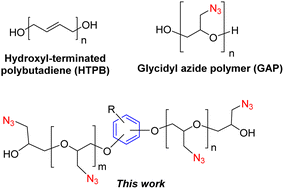
As a widely known class of energetic binders, glycidyl azide polymers (GAPs) exhibit high-energy characteristics owing to the presence of azide groups (explosophores) in their backbone structure. However, GAPs are limited by their poor mechanical properties compared with inert binders, such as hydroxyl-terminated polybutadiene. Therefore, efforts to simultaneously enhance the thermal and mechanical properties of GAPs are still ongoing. In this study, novel glycidyl azide polymers containing different aromatic diol units (2-nitroresorcinol, catechol, 1,2-benzenedimethanol, and 1,3-benzenedimethanol) were successfully synthesized by a two-step methodology starting from epichlorohydrin. The structure and thermal behavior of the synthesized GAPs were fully characterized by spectroscopic analyses, dynamic mechanical analysis (DMA), thermogravimetric analysis (TGA), and differential scanning calorimetry (DSC). Two promising polymers, namely, GAP-NR and GAP-3BM, were further cured with N100/IPDI to form polyurethane-GAP three-dimensional crosslinked networks. The resulting PU-GAP-NR and PU-GAP-3BM elastomers exhibited good mechanical properties, thermal stability and acceptable glass-transition temperatures. Based on these results, GAP-NR and GAP-3BM might serve as potential energetic binders for composite propellants.
 Please wait while we load your content...


