


 PLATFORM UPDATE:


Comparative efficacy of novel mono- and di-azomethine clubbed schiff bases against α-glucosidase and human bacterial pathogens: in vitro, molecular docking, and MD simulations

Abstract
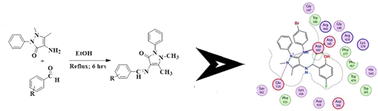
A series of new mono-azomethine (compounds 1–10) and di-azomethine (compounds 11–20) Schiff bases of 4-aminoantipyrine (compound 1–20) were synthesized, characterized, and evaluated for α-glucosidase inhibitory activity along with antibacterial potential in parallel to explore their broader pharmacological potential. In terms of antibacterial activity, mono-azomethine derivatives were generally more effective than di-azomethine analogues. In particular, compounds 5 and 6 with –OH substitution on the benzene ring presented excellent inhibition zones (51 ± 0.7 mm and 46 ± 0.5 mm against Salmonella typhi; 48 ± 0.6 mm and 43 ± 0.8 mm against Staphylococcus aureus respectively). Di-azomethine Schiff bases were found to be less effective as compared to mono-azomethine, presenting zones of inhibition at 38 ± 0.8 mm for compound 13 and 34 ± 0.9 mm for compound 10 against Staphylococcus aureus, and compound 19 at 37 ± 0.9 mm against Salmonella typhi. For α-glucosidase inhibition, the di-azomethine compound 12 (5-F, 2-OH substitution on one ring and 4-Br substitution on the other) demonstrated the most potent activity with an IC50 of 300 ± 22 µM. The mono-azomethine compound 8 (3,5-dimethoxy substitution) also showed strong inhibition (IC50 343 ± 20 µM), both superior to the standard drug acarbose (IC50 378.2 ± 0.12 µM). Molecular docking studies of the most active compound 12 revealed stable binding in the active site of α-glucosidase (PDB ID: 1XSK) involving conventional hydrogen bonding with Asp185 and Asp482, hydrophobic interactions, an RMSD of 1.8 Å, and a ΔG of −9.6 kcal mol−1. Since Schiff bases are reported to exhibit both enzyme inhibition and antimicrobial properties, such multi-target activities may provide leads for the development of multifunctional therapeutic agents.
 Please wait while we load your content...


