


 PLATFORM UPDATE:


Designing green-emissive Cu,N-codoped carbon dots by pyrolysis of aromatic precursors and application in sensing of Fe(iii) and Cr(vi)
 a
Nhu Vo
Thi Thu,
a
Minh Hao
Hoang,
a
Nham Linh
Nguyen,
a
Thanh-Sang
Nguyen,
a
Dat
Nguyen,
a
Nhiem
Ly,
a
Phuong V.
Pham
b
and
Dinh Khoi
Dang
*a
a
Nhu Vo
Thi Thu,
a
Minh Hao
Hoang,
a
Nham Linh
Nguyen,
a
Thanh-Sang
Nguyen,
a
Dat
Nguyen,
a
Nhiem
Ly,
a
Phuong V.
Pham
b
and
Dinh Khoi
Dang
*a
Abstract
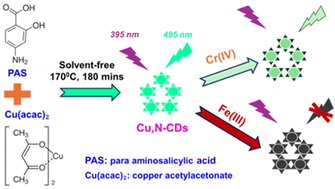
Detecting toxic transition metal ions using carbon dots (CDs) as fluorescent probes is efficient and sensitive, yet the rational design of CDs with controlled composition and tunable sensing selectivity remains a key challenge. Herein, we report the one-step, solvent-free pyrolysis synthesis of novel fluorescent Cu,N-co-doped carbon dots (Cu,N-CDs) from two aromatic precursors, p-aminosalicylic acid (PAS) and copper(II) acetylacetonate (Cu(acac)2), under mild conditions (170 °C, 3 h). The resultant Cu,N-CDs exhibited strong green fluorescence with a maximum emission at 495 nm under excitation at 395 nm and a quantum yield of 14.9%. Without further surface modification, these Cu,N-CDs demonstrated high performance as dual fluorescent probes for the simultaneous detection of Fe(III) and Cr(VI) ions. Upon excitation at 395 nm, introduction of either Fe(III) or Cr(VI) at 100 µM resulted in pronounced fluorescence quenching by factors of 50.3 and 3.53, respectively, through two mechanistically distinct pathways: Fe(III) quenching proceeds via formation of a non-fluorescent coordination complex with surface functional groups of the Cu,N-CDs, while Cr(VI) quenching arises primarily from the inner filter effect. The Cu,N-CDs offered high selectivity with low limits of detection for Fe(III) (1.48 µM) and Cr(VI) (19.6 nM). The scalable, solvent-free synthetic strategy and the dual-analyte sensing capability demonstrated here position these Cu,N-CDs as promising platforms for practical deployment in environmental water monitoring, food safety screening for detection of heavy metal pollutants.
 Please wait while we load your content...


