


 PLATFORM UPDATE:


Atmosphere-dependent synthesis and crystallization behavior of silica nanoparticles derived from rice husk biomass

Abstract
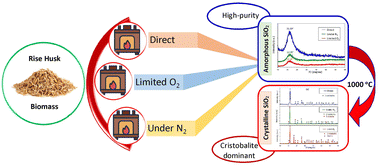
This work on sustainable nanomaterials focuses on their green synthesis methods using cheap and renewable precursors. In this study, silica nanoparticles (SiO2 NPs) were prepared from agro-waste biomass rice husk through an environmentally safe extraction process. Three controlled ashing conditions were used to determine the effect of the processing atmosphere on the end-product SiO2 NPs. Besides offering a reliable route to silica recovery, this process allowed one to control the phase and structure of the final nanostructures. The formation of high-purity SiO2 NPs was confirmed through characterization with the assistance of X-ray diffraction (XRD), Fourier transform infrared (FTIR) spectroscopy, field-emission-scanning electron microscopy (FE-SEM), energy-dispersive X-ray (EDX) spectroscopy, transmission electron microscopy (TEM) and zeta potential measurements. The as-synthesized nanoparticles exhibited a predominantly amorphous nature, with particle diameters ranging from 20 to 37 nm, and consisted of aggregated spherical grains. Post-synthesis thermal treatment at 1000 °C effectively induced a clear amorphous-to-crystalline phase change in the silica structure. This reaction caused the emergence of cristobalite-type silica, confirming that the structural stage and consequent morphology can be accurately engineered by the thermal treatment of the green-synthesised NPs. This study extensively highlights the enormous potential of rice husk biomass as a dual-use feedstock for waste valorization and the scalable production of SiO2 NPs, which can be further utilized for phase-associated functional applications.
 Please wait while we load your content...


