


 PLATFORM UPDATE:


Maximal electrocatalytic activity of Sr-doped Nd1−xSrxMnO3 perovskite oxides (x = 0.1, 0.2, 0.3) towards ORR: for next-generation power systems
 *a
*a
Abstract
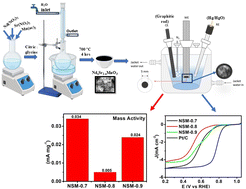
By using the sol–gel method, a series of Nd1−xSrxMnO3 perovskite oxides (x = 0.1, 0.2, 0.3), designated as NSM-0.9, NSM-0.8, and NSM-0.7, were prepared and characterized using analytical techniques including XRD, FESEM, TEM, EDS, and XPS. Our investigation revealed that NSM-0.7 (Nd0.7Sr0.3MnO3) is the most effective electrocatalyst for the oxygen reduction reaction (ORR). Its superior electrocatalytic performance in a 0.1 M KOH solution, evaluated with RDE and RRDE techniques, was quantified by an onset potential (Eon) of 0.82 V vs. RHE, a half-wave potential (E1/2) of 0.58 V vs. RHE, a limiting current density (JL) of −5 mA cm−2, which is the same as the current density of Pt/C, and a kinetic current density (Jk) of 0.41 mA cm−2 at 1600 rpm. This material also favoured a highly efficient 4e− pathway with the formation of a minimal amount of H2O2. NSM-0.7's superior catalytic performance is attributed to optimal Sr-doping at the perovskite's A-site, a process that significantly enhances its Mn valence and oxygen adsorption capacity. Furthermore, chronoamperometry confirmed that NSM-0.7 exhibits superior stability compared to the benchmark Pt/C catalyst, demonstrating that strategic A-site doping is a promising approach for improving conventional perovskite oxides for electrocatalytic applications.
 Please wait while we load your content...


