Issue 13, 2026, Issue in Progress

The onset of collective diffusion in hcp-iron: a combined theory of soft-matter and solid-state physics

Abstract

Lately, scientists have discovered the existence of collective diffusion in hcp-iron via machine-learning algorithms. This result has opened a promising avenue for geophysical studies on planetary cores. However, the crossover between collective and non-collective regimes remains very ambiguous. Based on the solid–liquid similarity, we develop a simple differential equation to infer the crossover temperature from the density scaling exponent, the isothermal bulk modulus, and the volumetric thermal expansivity. All necessary thermodynamic inputs are provided by the statistical moment method for nonlinear atomic vibrations. Our theoretical results are supported by the latest computational data on warm-dense iron crystals. From there, we find a possible explanation for prolonged controversies about melting relations in diamond-anvil-cell experiments. The potential impacts of collective diffusion on the core properties of icy, rocky, and gaseous planets are also considered by combining our mineral-physics calculations with modern geodynamic models.
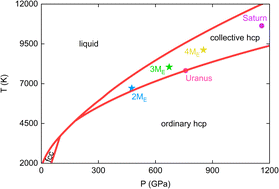
Graphical abstract: The onset of collective diffusion in hcp-iron: a combined theory of soft-matter and solid-state physics

Article information

Article type
Paper
Submitted
10 Jan 2026
Accepted
18 Feb 2026
First published
27 Feb 2026
This article is Open Access
Creative Commons BY-NC license

RSC Adv., 2026,16, 11391-11403

The onset of collective diffusion in hcp-iron: a combined theory of soft-matter and solid-state physics

T. D. Cuong and A. D. Phan, RSC Adv., 2026, 16, 11391 DOI: 10.1039/D6RA00258G

This article is licensed under a Creative Commons Attribution-NonCommercial 3.0 Unported Licence. You can use material from this article in other publications, without requesting further permission from the RSC, provided that the correct acknowledgement is given and it is not used for commercial purposes.

To request permission to reproduce material from this article in a commercial publication, please go to the Copyright Clearance Center request page.

If you are an author contributing to an RSC publication, you do not need to request permission provided correct acknowledgement is given.

If you are the author of this article, you do not need to request permission to reproduce figures and diagrams provided correct acknowledgement is given. If you want to reproduce the whole article in a third-party commercial publication (excluding your thesis/dissertation for which permission is not required) please go to the Copyright Clearance Center request page.

Read more about how to correctly acknowledge RSC content.

Social activity

Spotlight

Advertisements