


 PLATFORM UPDATE:


Thickness-dependent electro–chemo–mechanical modelling of SnS2/graphene anodes for high-performance potassium-ion batteries

Abstract
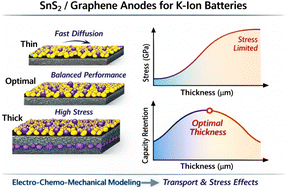
Potassium-ion batteries (KIBs) have emerged as a promising alternative to lithium-ion systems; nevertheless, their large-scale application is critically constrained by the coupled transport and mechanical degradation of high-capacity alloy-type anodes. In this study, a fully coupled electro–chemo–mechanical finite-element multiphysics framework is established to systematically investigate thickness-dependent transport behavior, stress evolution, and capacity degradation in SnS2/graphene nanocomposite anodes. Distinct from conventional electrochemical-only models, the proposed approach incorporates genuine bidirectional coupling, whereby potassium-ion concentration induces chemical strain and mechanical stress, while stress evolution dynamically modulates ionic diffusivity and reversible capacity. Numerical simulations performed over a wide electrode thickness range (5–40 µm) reveal a clear transition from diffusion-dominated behavior in thin electrodes to stress-limited operation in thicker, practically relevant configurations. Thin electrodes (∼5 µm) exhibit nearly homogeneous potassium distribution, low peak stresses (∼0.27 GPa), and negligible capacity decay, whereas thick electrodes (∼40 µm) develop severe concentration gradients, elevated stresses approaching ∼0.7 GPa, and accelerated stress-driven capacity fade. Notably, an optimal intermediate thickness of approximately 10 µm is identified, achieving a favorable balance between transport efficiency and mechanical stability with capacity retention exceeding 90% upon cycling. Quantitative agreement with experimental data for sub-5 nm SnS2/graphene anodes confirms the predictive capability of the model. This work provides mechanistic insight and practical design guidelines for the scalable development of mechanically robust, high-performance potassium-ion battery anodes.
 Please wait while we load your content...


