


 PLATFORM UPDATE:

Na2Cu2TeO6: a potential material for high solar cell efficiency and superior energy-harvesting performance
 *a
*a
Abstract
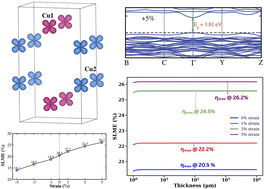
Materials having an antiferromagnetic (AFM) semiconducting ground state with a direct energy band gap (Eg) are attractive for photovoltaic (PV), energy-harvesting, and spintronic applications. In this work, numerous aspects of Na2Cu2TeO6 (NCTO) are systematically investigated using first-principles calculations under biaxial ([110]) strain. The compound is found to be thermodynamically and mechanically stable. The unstrained phase exhibits a robust AFM ground state arising from strong superexchange coupling with a calculated local spin moment of ∼0.9µB per Cu ion. The system possesses a direct Eg of 2.10 eV, with 100% accuracy compared to the experimental value. Under applied strain, the AFM ordering remains intact, while the Eg is tuned from 2.43 eV (−5%) to 1.81 eV (+5%) and retains its direct nature, leading to a pronounced enhancement of the PV rating. Notably, the spectroscopic limited maximum efficiency (SLME) increases from 20.47% in the unstrained case to a maximum value of 26.16% at +5% tensile strain, accompanied by a substantial rise in the short-circuit current density (Jsc = 19.01 mA cm−2) and a high fill factor (FF ≈ 0.914). Furthermore, the electron effective mass (m*) decreases from  , while the hole m* is reduced from
 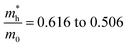 as the strain varies from −5% to +5%, indicating improved carrier mobility under tensile strain. Concurrently, the static dielectric constant exhibits a moderate increase from 3.76 to 3.89, leading to a reduction in the exciton binding energy (Eb) from 0.112 to 0.093 eV, which facilitates efficient charge separation. Additionally, thermoelectric analysis yields a high figure of merit of 0.81 at a −5% comparison at 1200 K, owing to an enhanced power factor and reduced lattice thermal conductivity. The Seebeck coefficient remains positive across all strain levels, indicating p-type conduction, while the electrical conductivity improves significantly under tensile strain. Collectively, these results demonstrate that biaxial strain is an effective route to simultaneously optimize the various physical features of the NCTO, establishing it as a promising multifunctional material for next-generation PV, energy-harvesting, and spin-dependent electronic devices.
 Please wait while we load your content...


