


 PLATFORM UPDATE:


One-pot-synthesized anthracene-based chemodosimeter for toxic cyanide (CN−) detection and anticancer analysis: substantiated by DFT, real-time investigations, and cytotoxicity assays
 *bc
Basheer
Aazaad,
f
*bc
Basheer
Aazaad,
f
Abstract
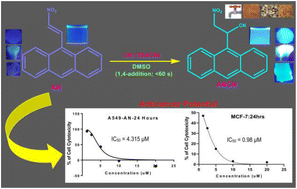
To preserve the ecosystem, researchers have recommended screening for CN− ions. For the detection of CN− ions, chemodosimetric probes play a defined role by affording diverse reaction-based responses. Here, (E/Z)-9-(2-nitrovinyl)anthracene (AN) was synthesized via a one-pot reaction between anthracene-9-carboxaldehyde and nitromethane. AN possesses anticancer activity and was employed as a chemodosimeter to detect CN− ions. In the presence of CN−, the “turn-on” photoluminescence (PL) emission enhancement at 420 nm was observed due to the formation of the 1,4-addition product ‘ANCN’. The maximum PL emission for ‘ANCN’ was achieved within one minute and was active across the pH range of 3–11. The AN-CN− detection system demonstrated linearity in the range of 0.01 to 500 µM, with a limit of detection (LOD) of 99.4 nM. The Job plot, based on the ultraviolet-visible (UV-vis) spectral investigation, revealed the 1 : 1 stoichiometric association between AN and CN−, with an association constant (Ka) of 2.81 × 10⁹ M−1. Multiple spectroscopic and density functional theory (DFT) studies confirmed the formation of ‘ANCN’. The energy gap variations of AN and ANCN were derived from DFT data. The analysis of strips, cotton swabs, fish pieces, real water, and herbal extracts confirmed the analytical performance of AN. The recovery of CN− ions in real water and herbal extract was between 84.36% and 101.61%, with <5% relative standard deviation (RSD). Cytotoxicity assays in cancerous (A549 and MCF-7) and non-cancerous (WI-38 and MCF-10) cell lines defined the anticancer efficacy of AN. These findings pave the way for similar designs in the future.
 Please wait while we load your content...


