Issue 16, 2026, Issue in Progress

Marigold-flower-like MoS2 nanosheet assemblies for enhanced alkaline hydrogen evolution

Abstract

The development of efficient, cost-effective, and noble-metal-free electrocatalysts is critical for sustainable hydrogen production via water splitting. Herein, hierarchical MoS2 nanosheets were synthesized through a facile hydrothermal method, producing a marigold flower-like morphology with abundant exposed edge sites. Structural and compositional analyses using XRD, Raman, XPS, SEM, and BET confirmed the formation of crystalline, layered, and mesoporous MoS2. Electrochemical evaluation in 1.0 M KOH revealed excellent hydrogen evolution reaction (HER) activity, with a low overpotential of 180 mV at 10 mA cm−2, a Tafel slope of 122.3 mV dec−1, and reduced charge-transfer resistance, highlighting efficient electron transport. Chronoamperometric measurements demonstrated outstanding long-term stability over 10 h. The combination of tailored morphology, high surface area, and favorable electronic structure establishes hydrothermally synthesized MoS2 as a promising and practical electrocatalyst for sustainable hydrogen generation.
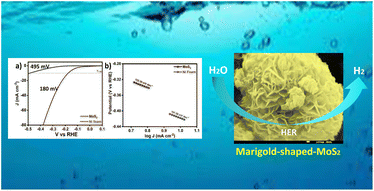
Graphical abstract: Marigold-flower-like MoS2 nanosheet assemblies for enhanced alkaline hydrogen evolution

Supplementary files

Transparent peer review

To support increased transparency, we offer authors the option to publish the peer review history alongside their article.

View this article’s peer review history

Article information

Article type
Paper
Submitted
01 Jan 2026
Accepted
25 Feb 2026
First published
17 Mar 2026
This article is Open Access
Creative Commons BY-NC license

RSC Adv., 2026,16, 14547-14554

Marigold-flower-like MoS2 nanosheet assemblies for enhanced alkaline hydrogen evolution

R. K. Chougale, P. D. Sanadi, S. N. Yadav, S. Masimukku, G. Chang-Chien, B. D. Bhosale and G. S. Kamble, RSC Adv., 2026, 16, 14547 DOI: 10.1039/D6RA00011H

This article is licensed under a Creative Commons Attribution-NonCommercial 3.0 Unported Licence. You can use material from this article in other publications, without requesting further permission from the RSC, provided that the correct acknowledgement is given and it is not used for commercial purposes.

To request permission to reproduce material from this article in a commercial publication, please go to the Copyright Clearance Center request page.

If you are an author contributing to an RSC publication, you do not need to request permission provided correct acknowledgement is given.

If you are the author of this article, you do not need to request permission to reproduce figures and diagrams provided correct acknowledgement is given. If you want to reproduce the whole article in a third-party commercial publication (excluding your thesis/dissertation for which permission is not required) please go to the Copyright Clearance Center request page.

Read more about how to correctly acknowledge RSC content.

Social activity

Spotlight

Advertisements