


 PLATFORM UPDATE:


Dynamic simulation study on gas flooding mechanism based on level set method at the micro–nano scale
 *a
*a
Abstract
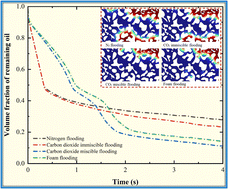
Gas flooding plays a crucial role in enhanced oil recovery; however, the underlying microscopic mechanisms, especially those related to interfacial changes, remain unclear. Based on a realistic geometric model of porous media, this study employs the level-set method to simulate the oil displacement processes of N2 flooding, CO2 immiscible flooding, CO2 miscible flooding, and foam flooding at the microscale. The oil–gas interface is tracked throughout the simulations to compare and analyze the displacement behaviors of different gases. First, a dynamic simulation of the gas flooding process is conducted, analyzing the variations in pressure, velocity, and remaining oil volume fraction over time. Second, the effects of factors such as injection rate, foam gas–liquid ratio, and surface tension on oil displacement efficiency are investigated. Finally, the displacement performance of N2 flooding, CO2 flooding, and foam flooding is compared under specific conditions to examine the oil recovery mechanisms associated with different gases. The results indicate that the remaining oil volume fractions after N2 flooding and CO2 immiscible flooding are approximately 30%. Increasing the injection rate of N2 and CO2 can improve early-stage displacement performance and slightly enhance oil recovery. In contrast, the remaining oil volume fractions after CO2 miscible flooding and foam flooding are about 10%. The optimal foam flooding effect is achieved at a gas–liquid ratio of 3 : 1 and a surface tension of 0.02, which corresponds to the lowest remaining oil volume fraction. Furthermore, the inlet pressure declines rapidly during N2 and CO2 immiscible flooding, resulting in a relatively low final pressure. In comparison, the inlet pressure decreases more gradually during CO2 miscible flooding and foam flooding, maintaining a certain pressure level by the end of the process.
 Please wait while we load your content...


