


 PLATFORM UPDATE:


A furano–ortho–vanillin conjugate for fluorogenic ratiometric and selective Zn2+ sensing: theoretical insights and biological studies
 *ab
Malay
Dolai
*c
*ab
Malay
Dolai
*c
Abstract
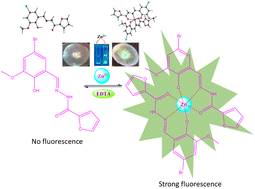
A fluorescent sensor BFC was designed and synthesized in order to identify the selective fluorescence recognition of Zn2+ in semi-aqueous environments. BFC notably displayed ratiometric red-shifted, twelve-fold fluorescence “turn-on” enhancement when exposed to Zn2+ at 490 nm with an isoemission point at 440 nm and a detection limit of 0.65 µM, which is considerably below the WHO (World Health Organisation) recommended value of Zn2+. The binding constant of BFC with Zn2+ was determined as 4 × 10⁴ M−1. The fluorescence enhancement of BFC in the presence of Zn2+ is attributed to the enhancement of charge transfer leading to high fluorescence via the CHEF mechanism. The binding interaction between BFC and Zn2+ was elucidated using UV-vis and fluorescence spectroscopy, supported by Job's plot analysis and theoretical insights from DFT calculations. For biological applications, BFC has been employed in plant-based cell imaging to monitor Zn2+ accumulation in Lathyrus sativus L. (grass pea). Overall, BFC presents a simple, effective, and promising fluorescent probe for ratiometric Zn2+ detection in diverse fields such as a versatile tool for Zn2+ detection in different applications like detoxification and marker molecules for bioabsorption.
 Please wait while we load your content...


