


 PLATFORM UPDATE:


Feathered innovation: transforming recycled keratin into bioactive micro/nanoparticles for bioactive keratin-based delivery platform

Abstract
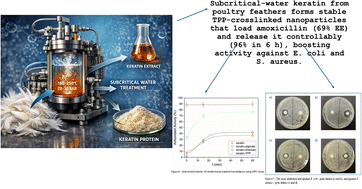
At present, great importance is dedicated to the use of waste biomass for the sustainable provision and fractionation of natural resources. This is particularly true for the production of biopolymers to promote the development of novel material products based on sustainability. This growing interest is driven by socioeconomic and environmental factors. Feathers from chickens are regarded as waste from the poultry meat production sector. These organic wastes serve as natural keratin sources for synthesizing nanoparticles to develop a new generation of multifunctional biocomposites for drug delivery purposes. Thus, in this research keratin was isolated from feathers by extraction in subcritical water (SubCW) at 180 °C, 20 bar for 1 h. This recycled keratin was used to develop advanced keratin-based particles. The aim of this study was to explore the potential of subcritically extracted keratin to form electrostatically stabilized particles with different types of interaction agents—namely natural polyelectrolytes and a multivalent ionic crosslinker (TPP)—and to evaluate their performance as a multifunctional keratin-based delivery platform. To investigate the complexation ability of keratin, three polyelectrolytes with different functional groups were used for particle synthesis at specific pH values, namely alginate with carboxyl groups, chitosan with amino groups, and penta-ionic sodium tripolyphosphate (TPP) with phosphate groups. Dynamic Light Scattering (DLS) analysis showed that complex formation between keratin-alginate and keratin-chitosan resulted in microparticles, and colloidal particles were formed only in the case of keratin-TPP. The ATR-FTIR spectra of the particles indicate that electrostatic interactions were the driving force for the complex formation between keratin and oppositely charged polyelectrolytes. The antioxidant activity of keratin diminishes upon the incorporation of alginate, chitosan, and TPP. The keratin-TPP particles, identified as optimal, underwent additional assessment as a keratin-based delivery platform for the model drug amoxicillin. UV/VIS spectroscopy indicated the successful encapsulation of amoxicillin (encapsulation efficiency of 69%), with a gradual release reaching up to 96% over a 6-hours period. Antimicrobial examination showed that the increased inhibition against both E. coli and S. aureus in the keratin-based delivery platform compared to pure amoxicillin can be attributed to the successful and controlled release of the drug from the particles. Consequently, these particles exhibit promising potential as a delivery system, offering simultaneous antioxidant and potentially antimicrobial properties. The potential resistance of amoxicillin is acknowledged, but amoxicillin remains a relevant model drug for initial exploration of keratin-based delivery platforms. Further studies may explore the combination with other antibiotics for enhanced efficacy. The safety and purity of SubCW-extracted keratin are assured as it undergoes rigorous analysis, including SDS-PAGE and FTIR spectroscopy.
 Please wait while we load your content...


