


 PLATFORM UPDATE:


Wet-spun Ag/PZT/TPU composite piezoelectric fibers with ultrahigh flexibility: fabrication, performance, and sensing response
 *ab
*ab
Abstract
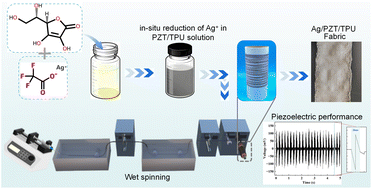
In the field of self-powered sensing, the demand for materials with enhanced wearing comfort and superior flexibility has become increasingly prominent, driven by the rapid advancement of wearable electronics and intelligent monitoring technologies. Although piezoelectric ceramics exhibit exceptional piezoelectric performance, their inherent brittleness and poor deformability severely restrict their practical applicability in flexible self-powered sensors. In pursuit of addressing the requirement for improved wearing comfort while retaining efficient energy conversion capability, elastomer-based composite fibers have emerged as a promising class of materials and developed rapidly in recent years. Nevertheless, a critical challenge remains in achieving uniform dispersion of fillers within the polymer matrix and the fabrication of defect-free composite fibers under high filler loading, primarily due to the significant surface energy discrepancy between the fillers and the polymer matrix. In this work, a novel thermoplastic polyurethane (TPU) based composite piezoelectric fiber with strong organic–inorganic interfacial adhesion and uniform high-content filler dispersion was proposed, achieved by interfacial modification of PZT and in situ reduced Ag nanoparticles (AgNPs) into TPU via wet spinning for flexible wearable piezoelectric sensors. Notably, even at total inorganic filler loadings surpassing 80 wt%, the resultant composite fibers maintain outstanding mechanical properties, with breaking strength >10 MPa and elongation at break >200%. When optimized with 80 wt% PZT and 3 wt% Ag precursor, the composite fibers, after weaving into fabrics and corona polarization, exhibit ultrahigh piezoelectric output sensitivity of 133 ± 2.1 mV N−1 and ultrafast response time (≈20 ms). This work offers a scalable fabrication route for high-performance piezoelectric fibers, which is helpful for self-powered sensors with better performance and more comfortable use in human motion monitoring and recognition.
 Please wait while we load your content...


