


 PLATFORM UPDATE:


Eco-friendly and sustainable gemini ionic liquid surfactants derived from coffee waste: design, surface activity, oil spill treatment, and antimicrobial performance

Abstract
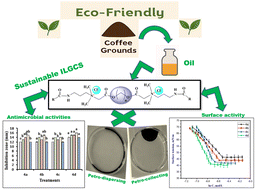
As environmentally safe substitutes for traditional solvents and surfactants, ionic liquids (ILs) have drawn a lot of interest. Among these, IL-based cationic surfactants constitute an important class of multifunctional materials that integrate the unique physicochemical characteristics of ionic liquids with the interfacial activity of surfactants. Due to their dual functionality, they have demonstrated broad applicability as corrosion inhibitors, antimicrobial agents, emulsifiers, and dispersants across the petroleum, pharmaceutical, and environmental sectors. In this case, precursors obtained from natural waste were used to create ionic liquid-based Gemini cationic surfactants (ILGCS) (4a–d). The first of the four primary phases in the synthetic approach was the separation of mixed fatty acids from discarded coffee grounds and culminating in a quaternization reaction to afford the target ILGCS. FT-IR, 1H and 13C NMR spectroscopy were used to completely describe compounds 4a–d. Their surface tension properties were systematically evaluated, and the ILGCS were further assessed for their efficiency as petro-collecting and petro-dispersing agents, in addition to their antimicrobial activity. The results showed that compound 4d recorded the highest surface activity, characterized by the lowest CMC, the largest surface pressure, and the lowest surface tension at micellization. This result suggests that 4d is a promising candidate for further applications that need strong surface activity, such as emulsification, detergency, or solubilization processes. The petro-collecting and dispersing properties of ILGCS (4a–d) were utilized on three different water sources that differ in salinity. All the synthesized gemini surfactants exhibited outstanding petroleum-dispersing efficiency in fresh and seawater. While in distilled water, the petroleum-collecting properties of the gemini surfactants were observed. Four ionic liquid-based Gemini surfactants (4a–d) were evaluated for antimicrobial activity after 24 h of exposure. Compound 4d (u = 6, m = 6) showed the highest inhibition zones against L. monocytogenes (17 mm) and S. aureus (16 mm), indicating strong activity against Gram-positive bacteria. Moderate inhibition was observed for Gram-negative strains E. coli (15 mm) and Salmonella sp. (14 mm), while Candida albicans showed lower susceptibility (13 mm).
 Please wait while we load your content...


