


 PLATFORM UPDATE:


Temperature-mediated microstructure evolution and densification mechanism of F2314 fluoropolymer binder during warm isostatic pressing

Abstract
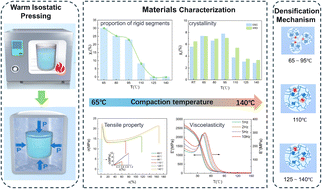
Polymer-bonded explosives (PBX) incorporate a fluoropolymer binder (F2314) as a critical component. The densification behavior of F2314 influences the microstructure and macroscopic properties of PBX, thereby determining the service performance of PBX components. A series of samples was prepared by isostatic pressing at temperatures between 65 and 140 °C to elucidate the influence of the compaction temperature on the densification mechanism of F2314. The results indicated that F2314 underwent successive phase transitions during heating, which included glass transition, cold crystallization, and partial melting. The crystallinity of F2314 initially increased, then decreased, accompanied by a progressive decline in the content of rigid segments. Increasing the compaction temperature significantly enhanced densification of the F2314 specimens, increasing the relative density from 88.6% to 99.5%, with stabilization above 95 °C. A distinct transition from brittle to ductile fracture behavior was observed between 95 and 110 °C, whereas the glass transition temperature and apparent activation energy remained relatively stable. The densification mechanism transitioned from mechanical interlocking at the particle scale at lower temperatures to the formation of an interpenetrating network structure at elevated temperatures. This transition was driven by enhanced molecular chain mobility, flow, and interdiffusion. In terms of process safety and mechanical performance, 125 °C was identified as the optimal compaction temperature for F2314. These findings establish a fundamental correlation among temperature, microstructure, and properties to provide a scientific basis for the optimized isostatic pressing of F2314-based PBX.
 Please wait while we load your content...


