


 PLATFORM UPDATE:


A novel cyan-emitting fluorescent α-amino acid: synthesis, photophysical characterization and live-cell imaging properties
 a
Maolin
Guo
*ab
a
Maolin
Guo
*ab
Abstract
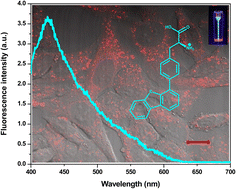
Small-molecule-based fluorescent probes, particularly fluorescent analogs of α-amino acids (FAAs), have become valuable tools for labeling proteins of interest and visualizing biological processes in living cells. In this study, we report the design, synthesis, and characterization of a novel cyan-emitting fluorescent α-amino acid, 4-dibenzothiophen-4-yl-L-phenylalanine (DBT-FAA). DBT-FAA was synthesized in good yield via a facile 3-step procedure involving modified Suzuki–Miyaura cross-coupling and characterized by spectroscopic methods. The compound exhibits strong fluorescence in a broad range of aqueous and polar solvents, with a major emission peak at ∼424–445 nm and secondary shoulders at longer wavelengths (∼448–583 nm), along with a high quantum yield (Φ = 0.74 in DMSO at λex = 380 nm and λem = 400–800 nm). DBT-FAA also demonstrates excellent photostability, showing strong resistance to photobleaching under aqueous conditions, which is essential for prolonged live-cell imaging. Confocal fluorescence microscopy confirmed that DBT-FAA is efficiently taken up by human HeLa cells, likely through an endocytic pathway, without observable cytotoxicity under the conditions studied. Once inside the cells, DBT-FAA initially accumulates in lysosomes and subsequently translocates to mitochondria with extended incubation time, suggesting dynamic intracellular redistribution. The robust optical properties, photostability, and cellular compatibility of DBT-FAA highlight its potential as a versatile fluorescent amino acid probe for real-time visualization of intracellular processes, offering promising applications in studying protein dynamics, molecular interactions, and cellular metabolism relevant to biochemistry, drug discovery, and protein engineering.
 Please wait while we load your content...


