


 PLATFORM UPDATE:


Pseudo-two-dimensional multiphysics modeling of mass transport and pseudo-enzymatic kinetics in Ti3C2Tx@Pt MXene-based glucose biosensors

Abstract
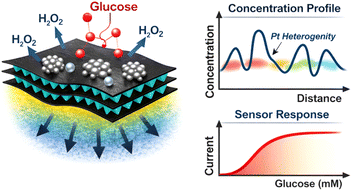
Accurate glucose sensing in nanozyme-based platforms is fundamentally governed by the coupled interplay between mass transport and surface-confined catalytic reactions, particularly in systems characterized by intrinsic nanoscale heterogeneity. In this work, a pseudo-two-dimensional (pseudo-2D) multiphysics modeling framework is developed to elucidate diffusion-reaction interactions in Ti3C2Tx@Pt MXene-based glucose biosensors by explicitly resolving two-dimensional diffusion of glucose and hydrogen peroxide in the electrolyte while confining pseudo-enzymatic reactions to laterally heterogeneous Pt catalytic domains described by Michaelis–Menten kinetics. The simulations demonstrate that non-uniform Pt site distributions induce pronounced local substrate depletion, lateral concentration gradients, and an effective thickening of the diffusion layer, resulting in transport bottlenecks that are not captured by conventional one-dimensional models. As a consequence, the pseudo-2D framework predicts a systematic reduction in effective glucose flux, premature saturation of the sensor response, and significant shifts in apparent kinetic parameters, including an increased effective Michaelis constant and a decreased maximum reaction rate, despite identical mean catalyst loading. In addition, the model reveals enhanced accumulation and delayed transport of hydrogen peroxide within the diffusion layer, directly modulating colorimetric signal intensity and response dynamics. Quantitative comparison with experimentally reported UV-vis absorbance spectra and electrochemical response trends shows excellent agreement across physiologically relevant glucose concentrations, confirming the predictive capability of the proposed approach. Overall, these findings highlight the critical role of lateral catalyst dispersion in governing mass transport limitations, apparent kinetics, and sensing performance, and establish the pseudo-2D multiphysics framework as a computationally efficient and physically rigorous tool for the rational design and optimization of heterogeneous MXene nanozyme-based glucose biosensors.
 Please wait while we load your content...


