


 PLATFORM UPDATE:


Next-generation CsPbBr3 perovskite nanocrystal chloride sensors: stability engineering and halide-exchange mechanisms in aqueous, biological, and environmental media

Abstract
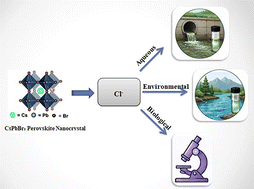
This review provides a comprehensive overview of next-generation Cesium lead bromide (CsPbBr3) perovskite nanocrystals (PNCs) for chloride ion sensing, with a focus on stability engineering and halide-exchange mechanisms. The article summarizes recent advances in structural and surface-engineering strategies—including core–shell architectures, polymer and inorganic encapsulation, compact surface ligands, and compositional modifications—that have been developed to enhance the environmental and chemical stability of CsPbBr3 PNCs in aqueous and complex media. In parallel, the fundamental principles governing halide exchange are described through established relationships such as lattice contraction, bandgap bowing, photoluminescence–composition correlations, exchange kinetics, and equilibrium behavior. These theoretical foundations are linked to the optical response of CsPbBr3-based chloride sensors and their fast, reversible spectral shifts. Furthermore, studies employing CsPbBr3 PNCs in aqueous, biological, and vapor environments are summarized, highlighting opportunities as well as common limitations related to stability, selectivity, and operational durability. Overall, this review consolidates current knowledge on engineering approaches and mechanistic understanding, providing a unified perspective on the design and performance of CsPbBr3 nanocrystal-based chloride sensing platforms.
 Please wait while we load your content...


