


 PLATFORM UPDATE:


Deprotonation-controlled copper-free Pd-catalyzed Sonogashira coupling versus the Kumada–Tamao–Corriu reaction: a DFT investigation toward anticancer carborane alkynes
 *b
*b
Abstract
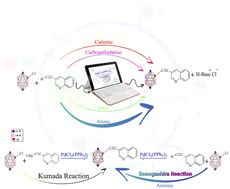
Carborane derivatives have emerged as valuable hydrophobic pharmacophores in medicinal chemistry owing to their unique electronic characteristics and rigid three-dimensional architectures. Here, density functional theory (DFT) calculations are used to dissect the copper-free Pd-catalyzed Sonogashira coupling that leads to 3-quinolylethynyl carborane alkynes and to benchmark this transformation against the Pd-catalyzed Kumada–Tamao–Corriu reaction for B–C bond formation. The Sonogashira manifold is analyzed in terms of four limiting scenarios: a carbopalladation route, cationic and anionic deprotonation pathways and an ionic pathway involving base-assisted chloride substitution at palladium. The carbopalladation route, although overall exergonic, is rendered kinetically inaccessible by a prohibitively high barrier for vinylic C–H deprotonation, whereas the cationic and ionic deprotonation mechanisms display substantially lower, but still moderate, activation free energies. In contrast, the anionic deprotonation pathway—initiated by base-promoted deprotonation of the terminal alkyne and electronic stabilization of the resulting acetylide by the 3-quinolyl group—features the lowest overall Gibbs free energy barrier and therefore emerges as the dominant mechanism under copper-free conditions. Comparison with the Kumada cycle shows that, while the latter is thermodynamically feasible, the key B–C bond-forming reductive elimination step is associated with a significantly higher barrier and delivers a less stable product than the corresponding Sonogashira outcome. Taken together with available experimental data, these results indicate that copper-free Sonogashira coupling with Pd(PPh3)2Cl2 is both kinetically and thermodynamically preferred for accessing 3-quinolylethynyl carborane alkynes, highlight these motifs as promising anticancer pharmacophores and provide mechanistic guidelines for the rational design of B–C bond-forming reactions in carborane chemistry.
 Please wait while we load your content...


