


 PLATFORM UPDATE:


Tetrad or triad? insights from a versatile Fe(ii) structural and functional model of the 3-histidine 1-carboxylate tetrad in C–C bond cleaving dioxygenase enzymes

Abstract
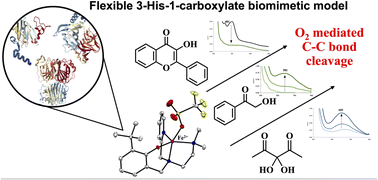
A new N3O coordinate ferrous complex modeling the 3-histidine-1-carboxylate tetrad – a dioxygenase active site – was synthesized and crystallographically characterized, ([Fe(II)(N-(ethyl-N′Me2)(Py)(2-t-ButPhOH))(OTf)]), 1. Complex 1 displays versatile C–C bond cleavage activity towards 2-hydroxyacetophenone, 3-hydroxyflavone, and 3,3-dihydroxypentan-2,4-dione in the presence of O2. This reactivity was studied through UV-vis and NMR spectroscopy alongside DFT calculations. The latter suggests that 1 forms an Fe(III)O2 adduct during the oxidation of 2-hydroxyacetophenone. Additionally, 1 displays direct activation of O2 in the absence of substrate, allowing it to access reactivity akin to more traditional N2O enzymatic coordination motifs. This versatility points to the need to reconsider mechanisms in N3O coordinate enzymatic systems and biomimetic models thereof. Moreover, this research makes the case that carefully designed N3O complexes merit further investigation as functional mimics of the canonical non-heme iron dioxygenase enzyme coordination environment.
 Please wait while we load your content...


