


 PLATFORM UPDATE:


Single-beam femtosecond Z-scan studies of bismuth and manganese co-doped titanium dioxide nanoparticles dispersed in ethanol

Abstract
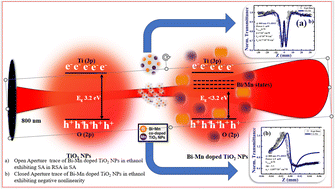
We report the femtosecond (fs) nonlinear optical (NLO) properties of simultaneously co-doped bismuth (Bi) and manganese (Mn) in titanium dioxide (TiO2) colloidal nanoparticles (NPs) dispersed in ethanol using ultrashort pulses of ∼150 femtoseconds (fs) duration at an input wavelength of ∼800 nm. The Bi and Mn co-doped TiO2 NPs were prepared by a deposition and precipitation method. The enhancement of the photoresponse of TiO2 (and the corresponding NPs) through metal doping has indeed become a promising area of research as it holds the potential to extend their applications in solar cells (as essential components), catalysis, and phototherapy. The band gap (3.2 eV) of the anatase crystalline phase of TiO2 NPs was reduced to 3.0 eV, 2.7 eV, and 2.5 eV upon co-doping with Bi–Mn at Bi concentrations of 2.5%, 5%, and 10%, respectively. The co-doping of Bi and Mn in TiO2 NPs significantly altered their band structure, enhancing their optical, mechanical, and chemical properties. A single beam Z-scan experiment was performed on Bi–Mn co-doped TiO2 NP colloids in ethanol exposed to 150 fs pulses, at 800 nm central wavelength. The open aperture (OA) Z-scan traces of Bi–Mn co-doped TiO2 NPs were obtained at a constant input power. The obtained NLO results demonstrated reverse saturable absorption (RSA) within saturable absorption (SA) and SA in RSA. The closed aperture (CA) Z-scan was also performed at 800 nm, displaying a negative value of the refractive index (intensity-dependent), which represents the self-defocusing effect. The typical orders of the estimated two-photon absorption (2PA) coefficients and the intensity-dependent refractive index (n2) were ∼10−6 cm W−1 and ∼10−7 cm2 W−1, respectively.
 Please wait while we load your content...


