


 PLATFORM UPDATE:


Synthesis and alkaline stability of Aquivion-based perfluorinated anion exchange membranes

Abstract
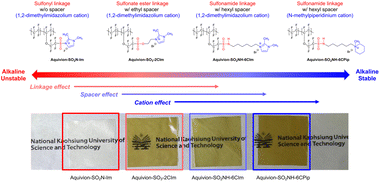
Quaternized perfluorinated polymers are promising anion exchange membranes (AEMs) for hydrogen energy devices due to their excellent dimensional stability and high ionic conductivity, which arise from limited ion exchange capacities (IECs) and well-developed hydrophilic/hydrophobic microphase-separated morphologies. However, their poor alkaline stability remains a critical challenge. In this study, a series of Aquivion-based perfluorinated AEMs was synthesized with varied tethering structures to systematically examine the effects of sulfonyl-containing linkages, alkyl spacers, and nitrogen-based cyclic cationic end groups on alkaline stability. We specifically introduced sulfonate ester linkages and alkaline-stable cationic groups, such as N-methylpiperidinium and 1,2-dimethylimidazolium, into perfluorinated AEMs, as these functionalities have not been previously used in such systems. Compared with the sulfonyl- and sulfonate ester-linked AEMs, the sulfonamide-linked AEMs incorporating hexyl spacers exhibited markedly enhanced alkaline stability by preventing hydrolytic cleavage of the linkage between the perfluoroalkyl ether side chains and cationic end groups. Among them, the AEM bearing N-methylpiperidinium end groups (Aquivion-SO2NH-6CPip) showed greater hydroxide conductivity retention (83.8%) after immersion in 1 M KOH at 60 °C for 192 h, while the AEM containing 1,2-dimethylimidazolium end groups (Aquivion-SO2NH-6CIm) achieved a higher hydroxide conductivity of 2.56 × 10⁻² S cm−1 at 80 °C. Both Aquivion-SO2NH-6CIm and Aquivion-SO2NH-6CPip demonstrated good potential in water electrolysis and fuel cell applications. Notably, the Aquivion-SO2NH-6CIm AEM exhibited good water electrolysis performance, achieving a high current density of 518 mA cm−2 at 2.2 V, which is comparable to that of the commercial Sustainion X37-RT membrane.
 Please wait while we load your content...


