Issue 13, 2026, Issue in Progress

Advanced additive manufacturing in orthopedics: a comprehensive review of biomaterials, structural design, biological functions and clinical technology applications

Abstract

Large bone defects resulting from trauma, disease, or congenital aberrations present a significant clinical challenge because they often exceed the body's natural healing capacity. While conventional 3D printing has revolutionized orthopedics by providing patient-specific anatomical replicates, these constructs remain inherently static and fail to adapt to the dynamic physiological environment of a healing bone. This review provides a comprehensive analysis of the transition toward 4D additive manufacturing in orthopedics, a landmark shift that integrates the dimension of time into tissue regeneration. We evaluate the strategic landscape of stimuli-responsive smart materials such as shape memory polymers (SMPs) and functionalized hydrogels, which execute programmed morphological or functional changes in response to triggers like body heat, pH, and magnetic fields.
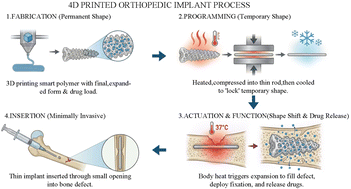
Graphical abstract: Advanced additive manufacturing in orthopedics: a comprehensive review of biomaterials, structural design, biological functions and clinical technology applications

Transparent peer review

To support increased transparency, we offer authors the option to publish the peer review history alongside their article.

View this article’s peer review history

Article information

Article type
Review Article
Submitted
09 Dec 2025
Accepted
30 Jan 2026
First published
02 Mar 2026
This article is Open Access
Creative Commons BY-NC license

RSC Adv., 2026,16, 11668-11685

Advanced additive manufacturing in orthopedics: a comprehensive review of biomaterials, structural design, biological functions and clinical technology applications

W. M. Chirume, C. Guo, D. Zheng, F. Ma, C. Fan, L. Li, L. Wang, C. Zhou and Q. Kong, RSC Adv., 2026, 16, 11668 DOI: 10.1039/D5RA09513A

This article is licensed under a Creative Commons Attribution-NonCommercial 3.0 Unported Licence. You can use material from this article in other publications, without requesting further permission from the RSC, provided that the correct acknowledgement is given and it is not used for commercial purposes.

To request permission to reproduce material from this article in a commercial publication, please go to the Copyright Clearance Center request page.

If you are an author contributing to an RSC publication, you do not need to request permission provided correct acknowledgement is given.

If you are the author of this article, you do not need to request permission to reproduce figures and diagrams provided correct acknowledgement is given. If you want to reproduce the whole article in a third-party commercial publication (excluding your thesis/dissertation for which permission is not required) please go to the Copyright Clearance Center request page.

Read more about how to correctly acknowledge RSC content.

Social activity

Spotlight

Advertisements