


 PLATFORM UPDATE:


Adsorption of methylisocyanate and ethylisocyanate on a Co-decorated TiS2 monolayer: understanding chemical interactions using DFT and COHP

Abstract
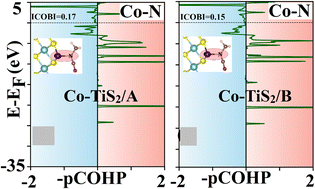
Designing efficient nanosensors is highly desirable for the detection of toxic substances. Herein, the adsorption behavior of the two specified VOCs, methylisocyanate (MIC) and ethylisocyanate (EIC), was investigated using density functional theory (DFT) and COHP calculations on pristine and cobalt-decorated titanium disulfide (Co–TiS2) monolayer systems. The decoration of Co on the TiS2 monolayer induces a semiconductor-to-metal transition in it. The stability of the Co–TiS2 monolayer system was confirmed by the calculated adsorption energy (Eads) of −3.18 eV. DFT calculations revealed that the pristine TiS2 monolayer systems are chemically inert towards the above-specified VOCs. However, functionalizing the TiS2 monolayer with a Co atom substantially improved the adsorption of MIC and EIC molecules. The estimated Eads values upon MIC and EIC adsorption on Co–TiS2 monolayer systems were −0.81 eV and −0.95 eV, respectively. The adsorption of the investigated VOCs changed the electronic and magnetic properties of Co–TiS2 monolayer systems, which were examined through spin-polarized density of states calculations. Bader charge analysis revealed that VOCs are charge acceptors and the Co–TiS2 monolayer is a charge donor. A considerable increase in work function was observed upon adsorption, correlating with sensitivity enhancements of up to 10% for MIC and 8% for EIC. COHP analysis revealed that both molecules interact with the adsorbent by forming Co–N ionic bonding caused by the Co(4s)-N(2s) orbital overlapping. The Ti–S, Co–S, and Co–N bonding pairs possess an ICOBI value of 0.32, 0.31, and 0.15, respectively, showing weak ionic bonding. Our findings propose that Co–TiS2 could be a better choice for the detection of MIC and EIC.
 Please wait while we load your content...


