


 PLATFORM UPDATE:


Optimization of p-SnS/n-CdS heterojunction solar cells via impedance spectroscopy and SCAPS modeling: impact of doping, thickness, and series resistance

Abstract
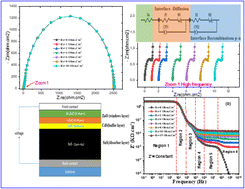
This work presents a detailed study of p-SnS/n-CdS heterojunction solar cells with Al–ZnO/i-ZnO window layers, combining simulations with the one-dimensional solar cell capacitance simulator (SCAPS-1D) and impedance spectroscopy for an in-depth investigation of the mechanisms limiting device performance. The effects of key cell parameters, such as absorber layer thickness, doping concentration, series resistance (Rs), and operating temperature, were systematically explored, as these factors strongly influence solar cell performance. Optimal efficiency was achieved with a 4 µm SnS absorber layer, resulting in a power conversion efficiency (PCE) of 22.76% and an open-circuit voltage (Voc) of 0.77 V under standard illumination conditions. Although increasing the Rs significantly degraded the fill factor (FF) and PCE, Voc and short-current density (Jsc) remained largely stable. The utility of complex impedance proved crucial in understanding the underlying physical mechanisms of each parameter (thickness, doping, Rs) and temperature, and their influence on overall efficiency. In the 0.1 Hz–1 GHz frequency range, two relaxation processes were revealed: a low-frequency response attributed to bulk recombination at the CdS/SnS interface, and a high-frequency response associated with interfacial polarization within the ZnO layers. Notably, the ZnO/CdS and CdS/SnS interfaces exhibited opposing thermal trends, reflected by the evolution of the relaxation times. The coupling between SCAPS-1D and the dynamic study via impedance spectroscopy highlights the importance of absorber doping, optimized thickness and minimized Rs as key parameters for obtaining high-efficiency SnS-based thin-film photovoltaic cells, and provides essential information on the interfacial dynamics and volumetric recombination processes that govern device performance and stability.
 Please wait while we load your content...


