


 PLATFORM UPDATE:


Towards the selectivity and energetics of anti-Bredt olefins – a density functional theory approach
 a
and
Padmesh
Anjukandi
*a
a
and
Padmesh
Anjukandi
*a
Abstract
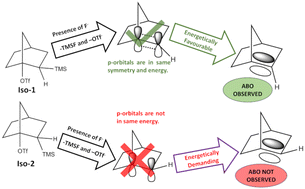
Anti-Bredt olefins (ABOs) are scarce owing to the double bond at bridgehead carbon in small bicyclic systems and also due to their effective geometrical constraints that hinder the p-orbital overlap. However, of late, people have been interested in synthesizing ABOs so as to harness their strain energy. Invention of novel stabilizing techniques and advancement in the synthesis procedures has led to a growing interest in these molecules. Recently, it was identified that a certain chemical precursor can be used to generate an ABO as an intermediate. The unique geometries and electronic properties of these could offer valuable alternatives synthetic routes in both medicinal chemistry and catalysis. In this study, we utilize Density Functional Theory (DFT) to comprehensively examine the energetics, reaction mechanism, and structural implications of ABO generation. Exhaustive energy profiling allows us to evaluate both the thermodynamic stability and kinetic barriers, revealing details about reaction feasibility. To summarize, this study offers a fundamental understanding of the molecular-level factors that influence the energetics, formation, and stability of ABO.
 Please wait while we load your content...


