


 PLATFORM UPDATE:

Catechol-derived propargyl diol cyclizations with malonyl dichloride: substituent effects on the formation of macrocyclic esters and their hydrochlorinated adducts

Abstract
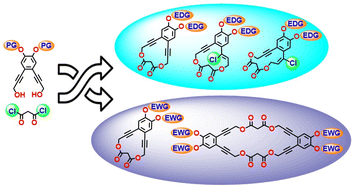
A series of catechol-derived propargyl diols were synthesized in the current study, and submitted to cyclization with malonyl dichloride, under basic conditions, to afford the corresponding 13-membered macrocyclic diesters. Product distribution appeared to be associated with the choice of protecting group for the catechol hydroxy substituents. Diverse protecting groups, able to fine-tune the (stereo)electronic contribution of each substituent to the π-conjugated system were investigated. In the cases of a trifluoromethanesulfonate-substituted or a conformationally-restricted cyclohexyl dioxolane-comprising propargyl diol substrate, as well as the O-substituent-free propargyl diol counterpart, the reaction led to the expected macrocyclization, alongside traces of a 26-membered macrocyclic tetraester, without any indication of a competing hydrochloride addition to a propargyl triple bond. However, upon switching to silyl or methyl groups as catecholic O-atom protecting groups, hydrochloride addition occurred on a triple bond under the cyclization conditions, leading to formation of macrocyclic, vinyl chloride adducts, along with the expected intact 13-membered macrocycle. In either case, no metal catalysis was required, while the reaction was performed at ambient temperature. Control experiments involving alternative conditions and hydrochlorination agents, which may form in situ in the original reaction, were conducted, to provide insight on mechanistic aspects.
 Please wait while we load your content...


