


 PLATFORM UPDATE:


Biocompatible protein–nanomaterial scaffolds for controlled drug delivery

Abstract
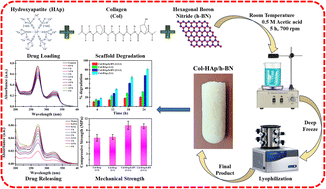
In this study, a series of collagen–hydroxyapatite (Col–HAp) composite scaffolds in the presence and absence of hexagonal boron nitride (h-BN) were fabricated using a controlled lyophilization technique to fabricate a functional biomaterial for drug delivery application. The lyophilization technique creates an interconnected porous network. The incorporation of h-BN in the Col–HAp/h-BN (1 : 2 : 1) scaffold prominently improved the mechanical strength of the scaffold, reaching 10.27 MPa as compared to the non-loaded h-BN scaffold, thereby enhancing its durability and structural stability. The loading of h-BN also displays a significant increase in surface area (47.27 m2 g−1), gaining abundant active sites for drug encapsulation. Circular dichroism (CD) spectroscopy confirmed the conformational behaviour of the collagen's secondary structure, indicating that in the presence of hydroxyapatite it preserved the native conformation and biological functionality. The Col–HAp/h-BN (1 : 2 : 1) scaffold revealed efficient ciprofloxacin (CIP) loading with a rate constant of 0.0719 h−1 which follows the first order kinetics, while the release process followed a second order kinetic model with a rate constant of 3.24 h−1, exhibiting a diffusion-based mechanism controlled by the scaffold's architecture. Enzymatic degradation assessment under a collagenase enzyme established that the Col–HAp/h-BN (1 : 2 : 1) scaffold underwent a gradual and sustained degradation pattern, as compared to other scaffolds, signifying that the incorporation of h-BN improved structural resistance and sustained biodegradability. In addition, biocompatibility studies revealed excellent cell viability, confirming the non-toxic and cytocompatibility nature of the scaffolds, validating the scaffold's safety for biological applications.
 Please wait while we load your content...


