


 PLATFORM UPDATE:

Understanding the charge-storage mechanism and interfacial kinetics of graphitic carbon nitride electrodes in redox-additive electrolytes for supercapacitors

Abstract
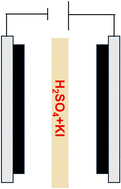
The addition of a redox additive to an aqueous electrolyte is one of the facile methods to enhance the electrochemical performance of carbon-based electrode materials. Furthermore, understanding the mechanisms and charge-transfer kinetics at electrode/electrolyte interfaces provides invaluable information, which enables the rational design of interfaces between the electrode and the electrolyte, thereby achieving optimal performance. Herein, we report the role of redox additives, namely, H2SO4 + K3Fe(CN)6 and H2SO4 + KI, in enhancing the capacitance performance of carbon-rich graphitic carbon nitride (CR-gCN). The cyclic voltammetry and galvanostatic charge–discharge revealed that CR-gCN exhibited superior charge storage in H2SO4 + KI, which is ∼3.5-fold higher than in pristine H2SO4 electrolyte. Although charge storage mechanism studies revealed that a diffusion-controlled process dominates the capacitance contribution in both electrolytes at lower scan rates, the H2SO4 + KI electrolyte shows a greater diffusive contribution at higher scan rates, indicating faster ion transport from the bulk to the electrode interfacial region. The charge transfer kinetics of CR-gCN in redox additive electrolytes investigated using modified Nicholson's method reveal that H2SO4 + KI electrolyte exhibits a heterogeneous charge transfer constant (k0eff) of 0.453 cm s−1, which is approximately 1.6 times higher than that of H2SO4 + K3Fe(CN)6, suggesting faster interfacial electron transfer. A symmetric device fabricated using H2SO4 + KI electrolyte exhibits a stable working voltage of 1.4 V and delivers an energy density of 37.65 Wh kg−1 at a power density of 3279 W kg−1. Furthermore, the device retains decent cycling stability over 10 000 cycles.
 Please wait while we load your content...


