


 PLATFORM UPDATE:


Unraveling the particle size characteristics-flame retardancy relationship in ATH/polyolefin composites: a focus on interfacial properties and thermal decomposition
 *ab
*ab
Abstract
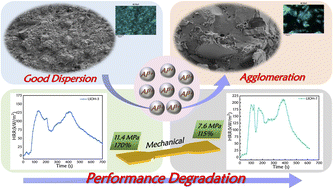
This study systematically investigates the influence of ATH particle size characteristics (D50 and SPAN) on the flame-retardant performance of ATH/polyolefin composites, and focuses on discussing the potential roles of interface properties and thermal decomposition behavior. Comprehensive analysis reveals that an ATH median particle size (D50) of 2.28 µm, coupled with a SPAN value of 2.19, achieves an optimal balance, facilitating uniform dispersion and strong interfacial adhesion within the polyolefin matrix. This optimal interface not only promotes the formation of a protective char barrier during combustion, as evidenced by a distinct bimodal HRR profile and significantly reduced peak HRR and total heat release values of 129.86 kW m−2 and 56.57 MJ m−2, respectively, but also enables the composite material to have the highest tensile strength and elongation at break, demonstrating the synergistic enhancement of flame retardancy and mechanical toughness. TG analysis confirms the superior thermal stability and enhanced residue integrity of this composite. In contrast, deviations from this optimal particle size—toward either finer or coarser distributions—result in particle agglomeration or interfacial defects, respectively, which compromise both flame-retardant efficiency and mechanical properties. Supported by SEM and EDS characterization, this work establishes a clear particle size–interface–performance relationship, providing scientific guideline for the precise design of high-performance flame-retardant polyolefins.
 Please wait while we load your content...


