


 PLATFORM UPDATE:


Room-temperature chemiresistive CO detection by PANi/GO nanocomposite sensors
 abc
Smagulova
Gaukhar,
*acd
Kazhdanbekov
Ramazan,
b
Kaidar
Bayan,
e
Efremov
Vladimir
a
and
Mansurov
Zulkhair
ab
abc
Smagulova
Gaukhar,
*acd
Kazhdanbekov
Ramazan,
b
Kaidar
Bayan,
e
Efremov
Vladimir
a
and
Mansurov
Zulkhair
ab
Abstract
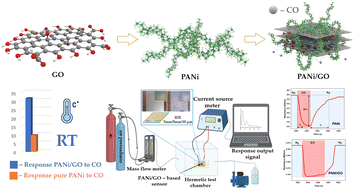
Against the backdrop of growing environmental and industrial risks, particularly those associated with toxic CO emissions, the development of highly sensitive gas sensors capable of operating stably at room temperature is of strategic importance. This work investigates composite materials based on polyaniline (PANi) and graphene oxide (GO) as promising sensing elements for carbon monoxide (CO) detection. It was found that pristine PANi exhibits limited gas sensitivity, yielding a response of only 9.7% upon CO exposure. The introduction of GO into the polymer matrix facilitates the formation of conductive pathways, increases the number of active adsorption sites, and accelerates charge transfer processes, resulting in a pronounced synergistic effect. Consequently, the PANi/GO composite achieves a response of 31.5%, which is nearly three times higher than that of pure PANi. A detailed comparative analysis indicates that the carbon nanostructures play a dual role: they enhance the conductivity of the system and activate surface gas–material interactions. Thus, the formation of hierarchical composites based on PANi and GO represents an effective strategy for enhancing the sensitivity and improving the dynamic characteristics of room-temperature CO sensors. The obtained results confirm the high potential of PANi/GO composites for applications in environmental monitoring systems, industrial safety, and next-generation intelligent sensor platforms.
 Please wait while we load your content...


