


 PLATFORM UPDATE:


Effects of Sn doping content on the structure, morphology, optical and electrical properties of ITO thin films prepared by microwave-assisted spray pyrolysis
 *abc
*abc
Abstract
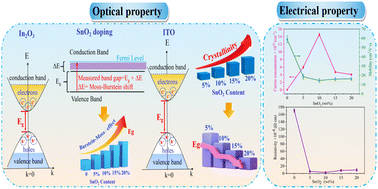
Indium tin oxide (ITO) thin films with different SnO2 doping contents (0–20 wt%) were successfully deposited via microwave-assisted spray pyrolysis. The structure, morphology, optical and electrical properties of the as-deposited films were systematically investigated. In contrast to the undoped In2O3 film, which exhibits a (222) preferential orientation, the SnO2-doped ITO films shows a shifted preferential preferential orientation toward (400) along with a reduced (400) diffraction intensity. This orientation change induces significant variations in crystal texture, surface morphology, film thickness, as well as optical and electrical properties. As the SnO2 doping content increased from 0 to 20 wt%, the thickness of the prepared films decreased continuously, while the surface roughness, the resistance, resistivity, and carrier concentration first decreased significantly and then increased. Notably, the 10 wt% SnO2-doped ITO film achieved substantially enhanced surface morphology, optical and electrical properties. This film is composed of regular spherical particles with a crystallite size of 43 nm, a root-mean-square roughnessof 5.27 nm, and a total thickness of 310.3 nm. Furthermore, it exhibited an 85.94% transmittance in the visible wavelength range relative to the quartz substrate, a band gap energy of 3.84 eV, a sheet resistance of 7.4 Ω sq−1 of, and a resistivity of 1.9×10⁻⁴ Ω cm, respectively. Compared with ITO films prepared by traditional spray pyrolysis or other method, this film possesses superior electircal conductivity while maintaining comparable optical transmittance. Thus, the ITO film doped with 10 wt% SnO2 is well-suited for electronic applications, particularly those requiring high-performance transparent conductive electrodes.
 Please wait while we load your content...


