


 PLATFORM UPDATE:

Bio-derived carbon adsorbents from Terminalia arjuna bark for efficient bisphenol A removal: mechanistic insights toward sustainable water treatment

Abstract
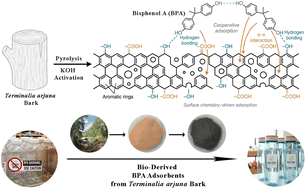
The development of sustainable sorbent materials capable of removing endocrine-disrupting contaminants from water is a pressing environmental challenge. In this study, bark powder of Terminalia arjuna (TABP), a traditional natural water purifying material, and its activated carbons (TAAC) were evaluated as bio-based adsorbents for the removal of bisphenol A (BPA), a pseudo-persistent and hazardous endocrine-disrupting chemical with significant risk to human health. Comprehensive characterization (FTIR, TGA, SEM-EDS, BET) revealed structural and chemical transformations during activation, including enhanced aromaticity and reduced oxygenated groups. Batch adsorption studies showed that bark material exhibited higher capacity (36.10 mg g−1), while activated charcoal derived at 500 °C achieved faster uptake (>95% removal in 30 min) with strong affinity (RL = 0.018). Isotherm analysis indicated that the combined Langmuir-Hill behaviour reflects site-limited adsorption with cooperative effects, consistent with dominant specific interactions rather than purely surface-area-driven physisorption. The Temkin model further suggested significant adsorbate–adsorbent interactions dominated by chemisorption. Kinetic analysis showed excellent agreement with the pseudo-second-order model (R2 > 0.998), supporting chemisorption as the rate-limiting step. These findings highlight the potential of Terminalia arjuna–derived adsorbents as promising precursors for developing efficient, renewable carbon adsorbents with well-defined molecular-level interactions. By coupling sustainability with mechanistic understanding, this work highlights design principles that can inform the development of next-generation sorbents for contaminant removal in resource-limited, and environmentally sensitive water treatment applications.
 Please wait while we load your content...


