


 PLATFORM UPDATE:

Valorization of cash crop waste into a decomposable nanocellulose adsorbent matrix through bacterial cell factories for the management of agricultural runoff contaminants
 *a
*a
Abstract
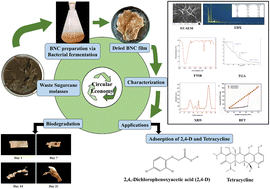
Agricultural runoff remains a pressing environmental concern, driven by the widespread use of herbicides and antibiotics in farming systems. In response, this study introduces a dual-purpose strategy that not only mitigates farming pollutants but also valorizes agro-industrial waste. Waste sugarcane molasses (WSM), an often-overlooked by-product, was repurposed as a sole carbon source for cultivating Komagataeibacter saccharivorans NUWB1, yielding 12.68 g L−1 bacterial nanocellulose (BNC) with superior structural and functional properties. Experimental findings revealed that BNC yield was strongly influenced by the surface-to-volume (S/V) ratio of the culture system, with higher S/V enhancing oxygen availability and biosynthesis efficiency. The resulting BNC featured a mesoporous nanofibrous architecture with a BET surface area of 89.42 m2 g−1, a crystallinity index of 88%, and demonstrated good thermal stability. As an eco-benign adsorbent, BNC achieved removal efficiencies exceeding 96% for tetracycline (TC) and 2,4-dichlorophenoxyacetic acid (2,4-D), fitting the Langmuir isotherm and pseudo-second-order kinetic models, and the material maintained its adsorption efficacy over five regeneration cycles. Biodegradation studies showed over 69% disintegration within 21 days under natural soil conditions. These outcomes highlight a circular bioeconomy model where waste becomes a resource, offering a scalable and biodegradable platform for pollutant remediation.
 Please wait while we load your content...


