


 PLATFORM UPDATE:


Performance-optimized N-doped CrCo2O4 nanoferrite integrated with CNTs: a high-performance photocatalyst for next-generation wastewater remediation

Abstract
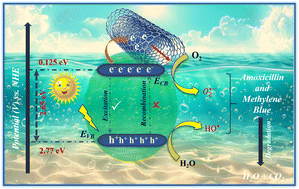
Photocatalysis offers a scalable route to safeguard water security by destroying persistent dyes and drug residues under sunlight. We report a dual-strategy enhancement of spinel chromium cobaltite (CrCo2O4, CCO) via nitrogen doping (NCCO) and carbon-nanotube (CNT) compositing (NCCO@CNTs), synthesized by wet-chemical precipitation (urea as N source) followed by ultrasonication with CNTs. XRD/FTIR confirm phase-pure spinel formation with N-induced lattice disorder; SEM/EDX show improved dispersion and homogeneous N/Cr/Co/O/C distribution; UV-Vis/Tauc reveal band-gap narrowing from ∼3.0 eV (CCO) to ∼2.65 eV (NCCO); transient photocurrent demonstrates possible effective charge separation in NCCO@CNTs. Under natural sunlight (7 ppm, 25 mg catalyst, 75 mL), NCCO@CNTs degrades methylene blue (MB) and amoxicillin (AMX) by 90.7% and 85% in 60 min, surpassing NCCO (65.7%, 62%) and CCO (49.5%, 47.5%). Pseudo-first-order kinetics yield rate constants k(MB) = 0.037, 0.017, 0.011 min−1 and k(AMX) = 0.030, 0.015, 0.010 min−1 for NCCO@CNTs, NCCO, and CCO, respectively (≥3× over pristine CCO). Radical-trapping pinpoints ˙O2− and ˙OH as dominant species, aligning with a mechanism wherein N-doping broadens visible-light absorption/creates shallow states, while CNTs act as rapid electron sinks, suppressing e−/h+ recombination and adding adsorption/active sites. Benchmarking against reported spinel's indicates competitive or superior sunlight activity. By optimizing the performance of CrCo2O4 through dual modification (nitrogen doping and CNT compositing), this work enhances its photocatalytic activity, enabling effective degradation of a wide range of chemically distinct pollutants, and offers a scalable solution for practical wastewater remediation.
 Please wait while we load your content...


