


 PLATFORM UPDATE:


Density functional theory-accelerated design of perovskite quantum dots: unlocking atomic-level control for next-generation optoelectronics and sensors

Abstract
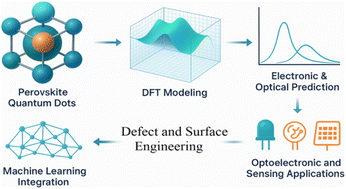
Density functional theory (DFT) accelerates the rational design of lead-halide and lead-free perovskite quantum dots (PQDs) by delivering atomic-level control over electronic structure, surface chemistry, and charge dynamics, with direct relevance to next-generation optoelectronics and sensing. Using hybrid functionals (HSE06 + SOC), spin–orbit coupling, and machine-learning integration, this study systematically maps bandgap tunability (1.8–3.0 eV via halide alloying), defect passivation (trap density <1015 cm−3 through ligand engineering), and interfacial charge transfer with sub-0.1 eV precision in CsPbX3 and related lead-free/hybrid systems. DFT-guided ligand coordination and dopant incorporation yield PLQY >95%, >1000 h humidity stability, and suppressed nonradiative recombination. Heterostructuring enables type-I exciton confinement and p–n junction formation, while adsorption-energy modeling reveals gas-surface interactions for ultrasensitive detection. Photocatalytic pathways show Ea reductions to 0.41 eV for CO2 → CH4 conversion under strain. These predictive insights—validated across LEDs, photodetectors, and sensors—establish DFT as a high-throughput engine for designing stable, defect-tolerant, and compositionally tunable PQDs, providing the most comprehensive DFT-driven framework to date for both lead-halide and emerging lead-free perovskite quantum dot technologies.
- This article is part of the themed collection: 2026 Reviews in RSC Advances
 Please wait while we load your content...


