


 PLATFORM UPDATE:


Boosting the adsorption and sensing performance of MoS2 for SF6 decomposition gases by non-metal atom doping:a DFT study
 *a
*a
Abstract
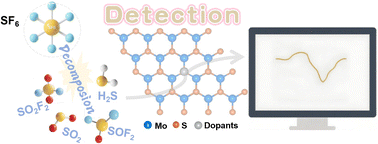
In electrical power systems, SF6 in Gas Insulated Switchgear (GIS) decomposes under partial discharge, yielding toxic products such as H2S, SO2, SOF2, SO2F2. Molybdenum disulfide (MoS2), a promising two-dimensional material, exhibits potential in gas sensing but its pristine form suffers from weak adsorption capacity for gas molecules. Herein, we carry out a systematic exploration of the gas-sensing capabilities of eight non-metal (NM)-doped MoS2 (NM@MoS2) materials toward SF6 decomposition gases by leveraging first-principles calculations. The results reveal that all NM@MoS2 substrates exhibit thermodynamic stability with negative binding energies ranging from −0.84 to −7.11 eV. Pristine MoS2 shows weak physisorption of target gases, accompanied by low adsorption energies (−0.21 to −0.33 eV), large adsorption distances (2.90 to 3.70 Å), minimal charge transfer and limited sensitivity. In contrast, the NM@MoS2 substrates demonstrate distinct adsorption behaviors: O@MoS2, Se@MoS2, and Te@MoS2 retain physical adsorption (adsorption energies: −0.14 to −0.37 eV; distances: 2.73 to 4.02 Å), whereas B@MoS2, C@MoS2, N@MoS2, P@MoS2, and Si@MoS2 demonstrate enhanced adsorption (adsorption energies: −0.39 to −1.67 eV; distances: 1.60 to 3.24 Å), accompanied by significant charge transfer and enhanced sensing-response. Of these substrates, Si@MoS2 demonstrates moderate recovery times at ambient temperature (2.82 s) and demonstrates significant sensing-response to SF6 decomposition components, highlighting its potential for practical gas sensing applications. This study demonstrates that non-metal doping can effectively enhance the gas-detection efficacy of MoS2 towards SF6 decomposition products, providing theoretical support for developing high-efficiency gas sensors.
 Please wait while we load your content...


