


 PLATFORM UPDATE:


Tuning dopant incorporation in tin oxide thin films using a methanol–water solvent for photovoltaic and water splitting applications
 *a
and
Muhammad
Saifullah
*d
*a
and
Muhammad
Saifullah
*d
Abstract
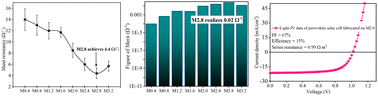
Fluorine-doped tin oxide (FTO) thin films serve as a good substrate for photovoltaic and electrochromic devices due to their outstanding optoelectronic features. The current study probes the profound impact of systematically varying the F/Sn molar ratio over a wide range on optoelectronic properties of spray pyrolyzed FTO thin films, leading to optimization of the F/Sn ratio for the methanol-to-water solvent system (9 : 1 v/v). A comprehensive suite of characterizations reveals that all FTO samples exhibit the tetragonal SnO2 phase with a preferred (200) orientation, while increasing the F/Sn ratio up to 2.8 (M2.8) enhances the crystallite size. Distinctive grain morphologies, including pyramidal, polygon-type, and bud-like structures, are observed across all samples. Optical transparency in the visible spectrum increases, reaching an impressive 79% for M2.8. Hall effect measurement confirms a significant rise in carrier concentration, with M2.8 showing the highest value. Additionally, M2.8 achieves the lowest sheet resistance of 4.4 Ω □−1 and an excellent figure of merit of 0.02 Ω−1 along with high thermochemical stability, making it an optimized candidate for high-performance applications. The practicability of optimized samples is demonstrated through their successful integration into perovskite solar cells, achieving a commendable power conversion efficiency of 15% under standard AM1.5 G illumination. The performance of indigenous substrates in water-splitting applications is comparable to commercial FTO thin films, underscoring their versatility. These findings emphasize the critical role of fine-tuning the F/Sn molar ratio for a specific solvent system to achieve superior optoelectronic properties of FTO thin films and pave the way for their widespread adoption in next-generation energy and electronic applications.
 Please wait while we load your content...


