


 PLATFORM UPDATE:


Design, synthesis, in vitro, and in silico studies on promising α-glucosidase inhibitors based on a quinazolinone–thiophene scaffold
 d
Somayeh
Mojtabavi,
g
Mohammad Ali
Faramarzi,
g
Shahrzad
Javanshir
*a
and
d
Somayeh
Mojtabavi,
g
Mohammad Ali
Faramarzi,
g
Shahrzad
Javanshir
*a
and
Abstract
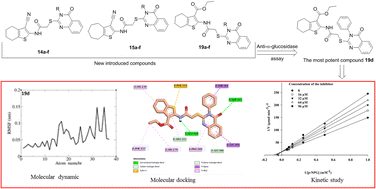
To discover novel inhibitors for α-glucosidase, a new scaffold featuring a quinazolinone–thiophene skeleton was designed through molecular hybridization. Eighteen derivatives, 14a–f, 15a–f, and 19a–f, were synthesized from this scaffold. These compounds were tested against yeast α-glucosidase. The in vitro enzymatic assays showed that all but one of the new compounds were active against α-glucosidase. The most potent compound was 19d, which inhibited the activity 11.7 times more effectively than acarbose, a standard inhibitor. In vitro kinetic studies demonstrated that this compound is a competitive inhibitor. Furthermore, in silico docking studies showed that compound 19d interacts with key residues in the active sites of both homology-modeled yeast and human α-glucosidase with favorable binding energies. Additionally, molecular dynamics simulations indicated that 19d formed a stable complex with this enzyme. Density functional theory (DFT) calculations provided further insight into the potency of the lead compounds. Based on the in vitro results, the most potent compounds were further examined in silico for druglikeness, pharmacokinetics, and toxicity. These evaluations revealed that, in terms of druglikeness and pharmacokinetics, the new compounds were similar to acarbose, while they showed better toxicity profiles. Furthermore, the most potent compounds exhibited low cytotoxicity against normal NIH-3T3 cells.
 Please wait while we load your content...


