


 PLATFORM UPDATE:


A high-copper-content metal–organic framework with potential antibacterial activities
 *a
and
*a
and
Abstract
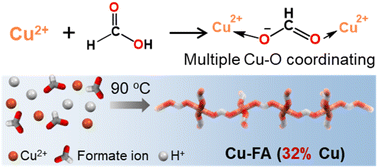
Despite recent significant advancements in antibacterial applications of copper-based metal–organic frameworks (Cu MOFs), the synthesis of a high-copper-content MOF remains elusive. Here we proposed a multi-coordination strategy through a direct solvothermal reaction of Cu ions and formic acid, which yielded a three-dimensional MOF (denoted as Cu-FA) containing 32% Cu. Through single crystal X-ray diffraction analyses, the precise spatial structure of Cu-FA was determined. Two types of Cu⋯O coordination bonds with varying bond energies were found in Cu-FA, enabling a multistage Cu release protocol to balance the antibacterial efficacy and biocompatibility. As a result, Cu-FA presented significant antibacterial activity against Escherichia coli, with an inactivation rate of 99.76%. Overall, this study not only establishes a viable strategy for synthesizing high-copper-content MOFs, deepening the understanding of their multilayer structures, but also providing a new insight into the exploration of antibacterial applications.
- This article is part of the themed collection: 2026 RSC Advances Popular Advances Collection
 Please wait while we load your content...


