


 PLATFORM UPDATE:


A palladium complex of 2,2′-(propane-1,3-diylbis(oxy))dibenzenaminium chloride on SBA-15 as a returnable, environmental and selective nanostructured-catalyst in the Suzuki C–C coupling reaction

Abstract
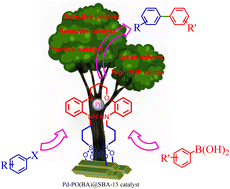
In this work, mesoporous SBA-15 was synthesized by a simple procedure using P123 and TEOS in HCl acidic conditions, followed by calcination at 550 °C. 2,2′-(Propane-1,3-diylbis(oxy))dibenzenaminium chloride ligand (PO(BA)) as ligand was synthesized from 2-nitrophenol and 1,3-dibromopropane, following reduction of nitro groups. The step-by-step synthesis of the PO(BA) ligand was confirmed by 1H NMR and 13C NMR. 3-Iodopropyltriethoxysilane (IPTES) was synthesized from 3-chloropropyltriethoxysilane (CPTES) in dry acetone. Then, the mesoporous SBA-15 surface was modified by IPTES and next it was functionalized by PO(BA). Finally, immobilized PO(BA) on SBA-15 became complex with palladium acetate (Pd-PO(BA)@SBA-15). The prepared Pd-PO(BA)@SBA-15 was characterized by SEM, ICP, TGA/DSC, EDS, BET/BJH, and WDX techniques. TGA and BET/BJH methods showed high thermal stability of this catalyst up to 230 °C and a high surface area for this catalyst. Then, the catalytic usage of Pd-PO(BA)@SBA-15 was investigated in the selective carbon–carbon bond formation. Various aryl halides (including aryl iodides (Ar–I) and aryl bromides (Ar–Br), having electron-donating or electron-withdrawing functional groups) and some derivatives of phenylboronic acid (such as phenylboronic acid, 4-methoxyphenylboronic acid and 4-formylphenylboronic acid) were investigated and all biphenyl products were obtained with high yields and TOF values. NMR spectroscopy was used to determine the synthesized biphenyl products. Pd-PO(BA)@SBA-15 catalyst was shown to be reusable without significant loss in its performance in the Suzuki–Miyaura cross-coupling reaction.
 Please wait while we load your content...


