


 PLATFORM UPDATE:


Exploring the diverse binding ability of SARS-CoV-2 variant RBDs to different antibody classes: a computational study

Abstract
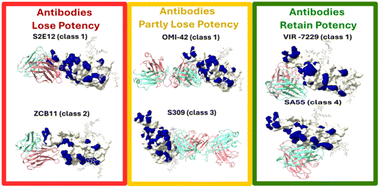
The receptor-binding domain (RBD) of the SARS-CoV-2 spike protein is highly immunogenic and structurally dynamic, resulting from continuous evolution and mutations that reshape its antigenic landscape. This study aims to investigate the binding profile between the RBD and four neutralizing antibodies, including class 1 (VIR-7229, S2E12, and OMI-42), class 2 (ZCB11), class 3 (S309), and class 4 (SA55), using computational approaches. These six RBD complexes were subjected to molecular dynamics simulation, and the binding free energy was estimated using the MM-PBSA method. Our results revealed that ZCB11 and S2E12 greatly weakened the binding to Omicron subvariants XBB.1.5, BA.2.86, KP.3, and MV.1, while OMI-42 was evaded by BA.2.86, KP.3, and MV.1. In addition, S309 exhibited a reduced binding affinity to the RBDs of XBB.1.5, BA.2.86, KP.3, and MV.1. Interestingly, glycans contribute approximately 33% to the interface interactions in variants with a single glycan at N343, increasing to 50% with a second glycan at N354. This finding indicates that dual glycans play a crucial role in determining the stability of the antibody–RBD complex. In contrast, SA55 and VIR-7229 demonstrated robust binding across all the studied variants. The viral evolution exhibits a two-tiered strategy to evade antibodies while enhancing ACE2 binding: first, charge-increasing mutations such as Q498R improve ACE2 affinity and repel antibodies like S2E12 and ZCB11; second, neutral mutations, such as F456L/V in KP.3 and MV.1, further weaken antibody binding, as observed in OMI-42. Our results support the charge-centric hypothesis that, although van der Waals interactions are favorable and nearly constant for all variants of a given class of antibodies, electrical interactions determine binding affinity as they vary from variant to variant.
 Please wait while we load your content...


