


 PLATFORM UPDATE:


Internal probe-external recognition immunosensor fabricated on nanochannels for reagent-free electrochemical detection of interleukin-1β
 *c
*c
Abstract
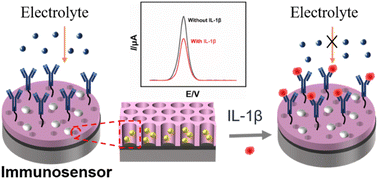
Highly sensitive and selective detection of interleukin-1β (IL-1β) enables dynamic monitoring of IL-1β levels in complex samples, providing significant clinical value for the prevention of early pathogenesis of urosepsis. Herein, a dual-functional “internal probe-external recognition” immunosensor was developed on nanochannel array, spatially separating signal generation from target recognition for label-free detection of IL-1β. A polydopamine (PDA) adhesive layer was utilized to stabilize the growth of amino-functionalized vertically-ordered mesoporous silica film (NH2-VMSF) on a glassy carbon electrode (GCE). Using the dual functionality of NH2-VMSF, gold nanoparticles (AuNPs) were electrochemically deposited within the NH2-VMSF nanochannels as immobilized electrochemical probes, while antibodies were covalently immobilized on the outer surface of NH2-VMSF to act as biological recognition elements. Upon binding with IL-1β, the immunosensor specifically recognized and captured the target, resulting in an increase in interface resistance and a corresponding decrease in the electrochemical signal of AuNPs. This mechanism enabled the quantitative analysis of IL-1β, with a linear detection range from 1 pg mL−1 to 100 ng mL−1 and a limit of detection (LOD) of 0.6 pg mL−1. The immunosensor was successfully applied to IL-1β detection in fetal bovine serum (FBS). By eliminating the need for additional signal probes, the developed immunosensor simplifies the detection process, demonstrates excellent anti-interference and stability, and offers a new approach for reagent-free biomarker detection in complex samples.
 Please wait while we load your content...


