


 PLATFORM UPDATE:


A green and sustainable approach using Thuja occidentalis-mediated Fe3O4 QDs decorated on rGO NSs for enhanced photocatalytic degradation of antibiotics

Abstract
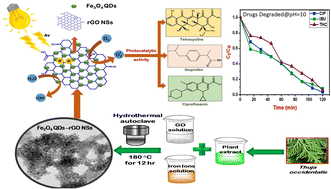
Emerging pharmaceutical contaminants such as antibiotics, personal care products, and anti-inflammatory drugs have become major environmental concerns due to their persistence and toxicity. In this study, Fe3O4 quantum dots supported on reduced graphene oxide nanosheets (Fe3O4 QDs–rGO NSs) were successfully synthesized via a green hydrothermal route using Thuja occidentalis leaf extract as a natural reducing and capping agent. The resulting nanocomposites (NCs) exhibited a high surface area (168 m2 g−1) and mesoporous structure (average pore size ≈14 nm), favouring pollutant adsorption and charge separation. Under visible-light irradiation, the Fe3O4 QDs–rGO NSs demonstrated superior photocatalytic performance toward pharmaceutical contaminants, achieving degradation efficiencies of 94.5% for ciprofloxacin (CIP), 76.2% for ibuprofen (IBU), and 90.7% for tetracycline (THC) within 120 min at an optimum catalyst dose of 5 mg and neutral pH ≈ 7. The apparent first-order rate constants (k) were 0.024, 0.017, and 0.012 min−1 for CIP, IBU, and THC, respectively. The nanocomposite retained over 90% of its photocatalytic efficiency after five reuse cycles, confirming its excellent stability and recyclability. The enhanced activity is attributed to the synergistic interaction between Fe3O4 QDs and rGO, which promotes efficient charge carrier separation and radical generation. These results highlight the potential of bioinspired Fe3O4 QDs–rGO NSs as an efficient, sustainable photocatalyst for wastewater remediation applications.
 Please wait while we load your content...


