


 PLATFORM UPDATE:


Color tuning in lanthanide ions doped upconversion nanocrystals
 *ab
and
*ab
and
Abstract
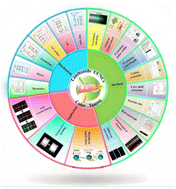
Lanthanide ions doped upconversion nanocrystals, capable of changing their dominant emission bands and thus colors, have attracted increasing attention because of their abundant implementation ways, high feasibility, wide tuning range, and finally great application prospects. The unique 4f ladder-like arranged energy levels of lanthanide ions are the key towards their color tuning ability. In this review, we present a summary and discussion on the key aspects of the recent progress in Lanthanide-based color-tunable upconversion nanocrystals, via manipulations of intrinsic properties of nanocrystals as well as external experimental configurations. Benefitting from the multifunctional and versatile luminescence bands, the color-tunable upconversion nanocrystals exhibit great potential in diversities of cutting-edge applications such as display device, advanced anti-counterfeiting, optical coding, thermochromic-based thermometer, bioimaging, biosensing, and multifunctional phototherapy. The prospectives and challenges for the research in color-tunable upconversion nanocrystals are also provided. This review would be helpful in designing and building new lanthanide-based upconversion nanomaterials capable of manipulating more precisely the dominant emission bands and expand their application boundaries.
- This article is part of the themed collection: 2026 Reviews in RSC Advances
 Please wait while we load your content...


