


 PLATFORM UPDATE:


Permanent electrostatic moments through the lens of atoms: assessing variational Hirshfeld methods

Abstract
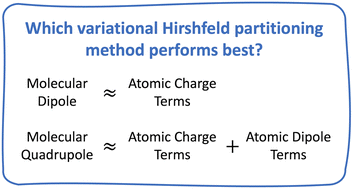
Atomic multipoles are key components of many computational models; however, there is no unique method for computing them. This motivates our benchmark study to evaluate how accurately the atomic moments from variational methods approximate the molecular moments, offering insight into their ability to capture the underlying electron density. We show the chemical utility of higher-order atomic multipoles and demonstrate their conformational stability across diverse organic and inorganic molecules and protein fragments. We focus on the recently proposed Additive Variational Hirshfeld (AVH) method and compare its performance to two other popular variational Hirshfeld approaches, the Iterative Hirshfeld (HI) and Minimal Basis Iterative Stockholder (MBIS) methods, as well as the Charge Model 5 (CM5) and electrostatic potential fitted charges. We first show that commonly used integration grids can introduce significant numerical errors, undermining the reliability of quantitative comparisons of atomic dipoles and quadrupoles. We then demonstrate that while AVH charges may not always provide the most accurate approximation of molecular moments on their own, they outperform HI and MBIS in approximating the molecular quadrupole when atomic dipoles are taken into account. More severely, for HI and MBIS, the addition of atomic dipoles can sometimes increase the molecular quadrupole error. These findings suggest that AVH moments offer a more systematic improvement with increasing multipole order.
 Please wait while we load your content...


