


 PLATFORM UPDATE:


In situ synthesis of aluminum/copper-doped carbon dots from magnetite graphene oxide-carboxymethyl cellulose-2-acrylamido-2-methyl-1-propanesulfonic acid hydrogel and their electrical characterization
 a
Mohamed
El-Sakhawy
*a
and
a
Mohamed
El-Sakhawy
*a
and
Abstract
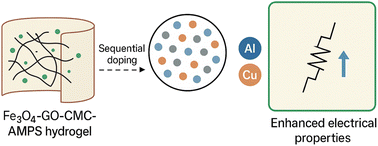
The recycling of agricultural residues into functional nanomaterials offers a sustainable pathway for next-generation electronics and energy devices. In this study, sugarcane bagasse was valorized to synthesize aluminum/copper-doped carbon dots (Al/Cu-CDs) embedded in a magnetite-graphene oxide (Fe3O4-GO) reinforced carboxymethyl cellulose–2-acrylamido-2-methyl-1-propanesulfonic acid (CMC-AMPS) hydrogel by a sustainable, in situ one-pot microwave-assisted approach. The sequential doping of Al and Cu ions in the carbon dots enables precise tuning of electronic structure, leading to significantly enhanced electrical conductivity, permittivity, and charge storage capacity compared to undoped analogs. Physicochemical characterizations, including FTIR, TEM, and UV-vis spectroscopy, confirm uniform nanoparticle distribution, and nanoscale features, with particle sizes in the range of 2.8–5.4 nm for Cu-CDs and 5.0–5.4 nm for Al/Cu-CDs. The resulting composite exhibits enhanced multifunctionality, combining magnetic, conductive, and biocompatible properties. Electrical measurements revealed a four-decade increase in conductivity and permittivity upon aluminum doping, alongside reduced impedance, indicating superior charge mobility. These findings demonstrate that the sustainable Al/Cu–Fe3O4/GO-CMC-AMPS nanocomposite is a promising candidate for applications in energy storage, supercapacitors, and biosensing applications.
 Please wait while we load your content...


